Monday, August 29, 2011

Garden Lessons Learned

I am not the perfect gardener, yes I will say it again I AM NOT THE PERFECT GARDENER!  Sometimes you just have to jump in and try things.  Sometimes they succeed and sometimes they fail miserably.    You just have to be willing to try.  The same is true outside of the garden.  For example, I often lead lots of computer trainings at work.  The biggest problem I see is that people are afraid to try things.  They think if they push the wrong button or click the wrong area the computer is going to explode or something.  The reality is that the best way to learn the computer is to try things and learn from mistakes and successes.  The same is true with gardening.  Here are some things I have learned from gardening:


  • If you see something cool growing in someone's yard, before asking if you can have some make sure it's not growing ALL over their yard.  Definite things to stay away from: Loosestrife of any kind, Bishop's Weed or Snow on the Mountain, etc.  No matter how cool that Gooseneck Loosestrife looks, it's not cool when you have to try to eradicate it from your garden for years to come.
  • Always water new plants well after planting them.  Don't be lazy and wait for the next rainfall to come.  An unwatered plant is a dead plant.
  • Almost all of those plant catalogs you get in the mail in winter, though tempting, are not worth ordering from (unless it's seed catalogs).  More than likely you will receive plants the size of your pinky that will be dead upon arrival or die within a couple of weeks.  It's always best to buy plants local where you can see them, or from reputable mail order companies.  Look at Garden Watchdog before ordering from any garden company.
  • In my experience, almost all those cool colored coneflowers eventually revert back to all pink.  Green Envy and the white ones have been the exception for me.
  • If your containers are not near a water source, it's best to make your container self-watering so you don't have to water them by hand every day during dry spells.  
  • Setting up a drip-line system is easy, and it beats dragging a hose around the yard to water all the time.
  • As much as you want to share your hostas with friends, let them grow a few years before deciding to divide them.  
  • Never leave your husband home alone with a loppers in your garden.
  • NEVER use landscaping fabric.  It dries out your plants, weeds still grow on top of it, and it's very hard to dig through it if you want to add plants.  Instead use cardboard to line your new garden beds.
  • Rocks are only good for cactus and succulents garden.  Unless it's big rocks you will use to line flower beds or add interest to your garden.  
  • Don't plant things too close together, either the strongest plant will survive or you will have to dig it out and move it down the road.
I'm sure I could rattle off a ton more, but what lessons have you learned in the garden?

Saturday, August 27, 2011

Hosta Shoulder

My big posts may be a little less for a few weeks. I am one handed typing until my shoulder heals.  I had surgery to remove bone spurs from my shoulder and hope the surgery will bring back full range of motion, which I haven't had for a long time.  We are referring to it as hosta shoulder.


Thursday, August 25, 2011

Eastern Tiger Swallowtail

The Eastern Tiger Swallowtail butterfly is a common site in my yard.  They are especially attracted to the Joe Pye Weed.
Male and Female Eastern Tiger Swallowtail.

This is the black form of the Eastern Tiger Swallowtail female.  The female can also be yellow instead of black.

The male Eastern Tiger Swallowtail.

A close-up of the female.

Tuesday, August 23, 2011

Monarchs and Milkweed

Yesterday I blogged about those icky garden spiders, and so I figured today would be a good day to blog about the graceful Monarch butterfly.  The Monarchs love the flowers on my milkweed, Joe Pye Weed, and Blazing Meadow Star plants.  If you have ever tried to take a picture of a Monarch, you know that they are very active.  I like to think of them as the ADHD butterfly.  As I watch the Monarchs on my milkweed, I noticed that they preferred the closed flowers of the milkweed over the ones that were blooming.  Monarchs will only lay their eggs on milkweed plants.  The sap of the milkweed is poisonous, and by laying their eggs on the milkweed the butterflies are protecting them from predators.  The milkweed in the photos is swamp milkweed, but I also have common milkweed that seeds itself in my garden.  Common milkweed can become aggressive, so it's best to pull the plants or cut the seed pods off of them before they dry and open.  However, before you pull the plants make sure no Monarch eggs or caterpillars are on the plant.  Monarchs do not live in Wisconsin year round.  Instead they fly south for the winter.  They do not return, as the longest lifespan of a Monarch is about 8 months.  Instead it's the Monarch's relatives that return in summer.


This is a female Monarch, because the lines are thick.  Males usually have thinner lines, and they also have black spots on their bottom two wings.

Monday, August 22, 2011

Garden Spiders

Ever since I happened to watch Kindgom of the Spiders when I was very small, I have loathed spiders.  Honestly, I have had nightmares about spiders ever since I saw that movie.  My fear of spiders is so great, I almost jumped out of a moving car one day when saw a huge spider crawling across the dashboard.  I'm sorry all of you who love spiders, but if you are a spider and in my house, you will be dead.  Not by my hand, of course, because I am not going anywhere near you.  I will just be silently screaming, frozen in fear, and pointing at you, until my husband or one of my cats kills you.  If I would have known how much cats love to eat spiders, I would have had cats a long time ago.  

So I bet you would be surprised to learn that I actually welcome garden spiders.  I have even taken a stick (a very long stick) and moved them out of my way.  Who couldn't like something that eats mosquitoes!  Garden Spiders have never charged at me, like some of those house spiders.  They are not plotting my demise, like those house spiders.  They have never tried to crawl into my bed, like some of those house spiders.  So if they leave me alone, I leave them alone.  I usually find them in my garden in late spring as tiny baby spiders, and don't notice them again until late summer/early fall when they are so big you can't miss them.  Ok, I will admit they still freak me out a little because they are everywhere....and I mean everywhere.  It's hard to walk into the garden without running into one of their webs, which are very strong.  After a while I do a mental inventory of where they are, and I try to avoid those areas.  I'm pretty sure if one of these spiders crawl on me I would die of fear, but for now I actually enjoy watching them (from a distance).
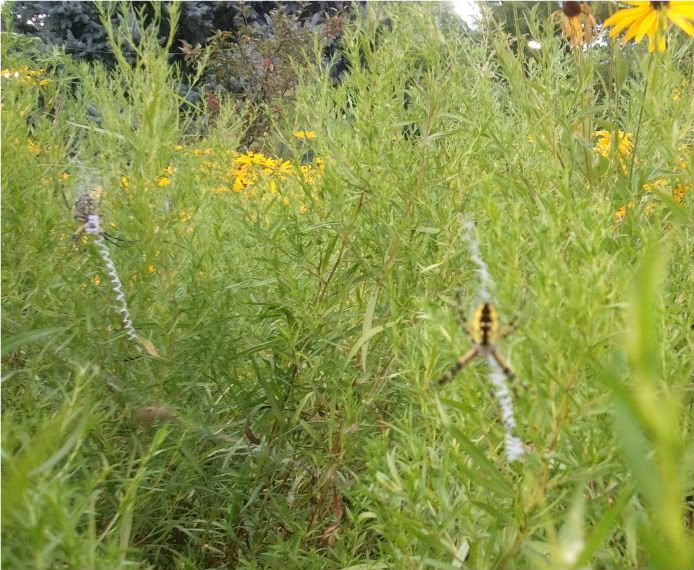
Black and Yellow Garden Spiders

European Garden Spiders


Stretch spider